

Research
Atmospheric water harvesting
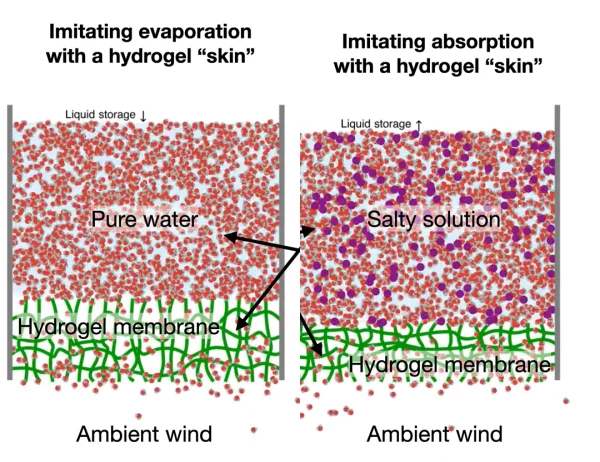
There is an astonishing amount of fresh water floating over our heads—more in the air than in every river on Earth put together. Getting it down is the hard part. Most approaches use a sponge-like solid that soaks up vapor and then has to be heated to wring it back out, and that wringing-out step is slow and thirsty for energy. We wondered whether you could skip it altogether. Nature had already worked this out: tree frogs and airplants breathe water in and out through their skin, so we made a hydrogel “skin” of our own. Rather than storing water in the gel, we let vapor pass straight through it into a salty liquid underneath—the salt does the pulling, and the gel simply gets out of the way. The water arrives as a liquid from the very beginning, so there is nothing to wring out, and it keeps working even when the air is dry enough to feel parched [19]. The technology is promising enough that we have spun it out into a startup, WAVR Technologies, to develop it commercially. Relevant publications: [19], [13], [14].
Electrochemical ironmaking
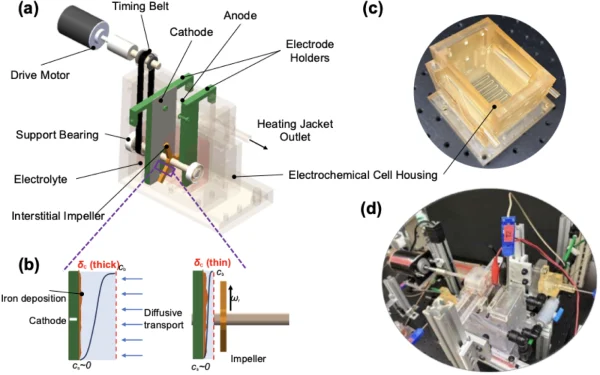
Making iron is one of the dirtiest things we do at scale. A blast furnace burns coal not only for heat but as the chemical that tears oxygen away from the ore, and the world’s furnaces together account for a sizable slice of all human carbon emissions. There is another way: you can make iron with electricity, in something closer to a hot bath than a furnace, and if that electricity is clean then the carbon problem largely disappears. So why isn’t everyone doing it? Speed. Run the process hard and the surface where iron is forming strips the nearby liquid of everything it needs, faster than fresh material can drift in to replace it. The reaction starves at exactly the spot that matters. Stirring the tank barely helps, because a stubborn stagnant film clings to the electrode no matter how vigorously you churn the rest. Our fix is almost cheeky in its simplicity: we put a small impeller in the gap between the electrodes, so the stirring happens right where the starving is. The same electricity then makes considerably more iron, and the metal grows smooth and dense instead of sprouting the spiky fingers that usually ruin fast plating [21]. This work is supported by the Department of Energy’s ARPA-E ROSIE program, together with the University of Nevada, Reno and the University of Houston. Relevant publication: [21].
Transport through hydrogels
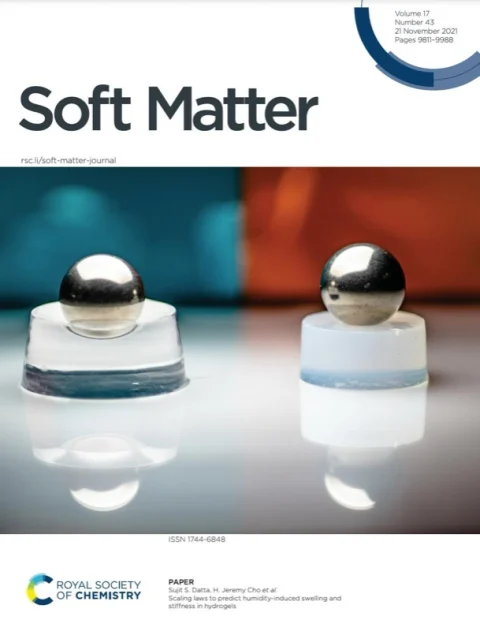
We explore non-traditional “soft” matter—hydrogels above all—to develop fundamentally new technologies across the energy, environmental, and biomedical spaces. A hydrogel is mostly water, held in a floppy polymer net, and that net turns out to be a wonderfully tunable thing: dry it, squeeze it, or change what is dissolved around it, and its stiffness and its permeability shift together. Working that out from the molecular structure upward is what lets us use gels as tools everywhere else—the membrane “skin” in our water harvesting work is one gel doing a job we understood first in the abstract. Along the way we have watched hydrogel packings crack and then quietly heal themselves shut [9, 10], and we have worked out scaling laws that predict how a gel swells and stiffens as the humidity around it changes [13, 14]. Relevant publications: [9], [10], [12], [13], [14].
Interfacial science
From phase-change heat transfer to lung function to oil recovery to underground mining, the interfacial properties at the liquid-vapor-solid boundaries dictate that complex phenomena. These could increase forces required for flow or cause undesirable flow characteristics. We look at how surfactants can be used to tune these behaviors by understanding how they work from their fundamental chemistry. Measuring any of this well turns out to be a puzzle of its own. Photographers call the little glint of a lamp reflected in someone’s eye a “catch light”, and we realized you can run that backwards: if you know where the lamps are, the glints scattered across a droplet tell you the shape of its surface. One ordinary photograph is then enough to rebuild the entire three-dimensional drop—no guessing, no curve fitting [20]. Relevant publications: [6], [8], [15], [20].
Phase-change heat transfer
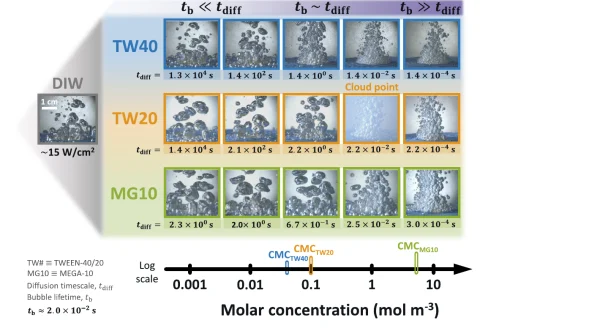
How can we use and convert energy more efficiently? That, essentially, is the question we seek to answer in many ways through our research. Energy conversion often involves the movement of heat. And one of the most effective ways to move heat is through phase-change processes like boiling and condensation. This is why the majority of power plants use a steam cycle to convert a heat source (fossil fuel, solar, geothermal, etc.) into electricity. We look at how boilers and condensers can be made to transfer energy more effectively using new materials. Many existing thermal technologies deal only with the three traditional phases of matter: pure liquids, gases, and solids. However, there are a multitude of complex and exciting behaviors when we use non-traditional matter. For instance, we can add molecules called surfactants that change how a liquid wets a surface (think about how water droplets would bead up and slide on a waterproof jacket versus soak a cotton shirt). These surfactants enable control of boiling—even to the point of turning boiling on and off using electric fields. Relevant publications: [2], [4], [11], [15].